What is Vara.eth?
A high-performance, bridgeless application platform built directly into Ethereum's ecosystem.
What is Vara.eth?
Vara.eth is a high-performance application platform built directly into Ethereum. It lets you build applications that were previously impossible on-chain — real-time order books, on-chain AI inference, complex game logic — with instant feedback and no gas fees for users.
Your program runs off-chain in a decentralized network of validators, but its state is anchored to Ethereum L1. Users interact through normal Ethereum contracts. No bridging, no new chain, no fragmented liquidity.
Under the hood, Vara.eth uses the Gear Protocol execution engine — the same battle-tested runtime that powers Vara Network.
Mental Model
When you deploy a Vara.eth program, here's what actually happens:
Program
Your Rust code compiled to WASM. It runs off-chain in the Gear runtime but behaves like an isolated Ethereum contract with its own state and message queue (actor model).
Mirror Contract
The on-chain "face" of your program. Users call it like any Solidity contract: mirror.sendMessage(payload). The Mirror represents your program's state on Ethereum L1.
Executors
A decentralized network of validator nodes that execute your WASM program, process messages in parallel, and collectively sign the results.
Router Contract
The central L1 contract that verifies validator signatures, finalizes execution batches, and anchors all state transitions to Ethereum.
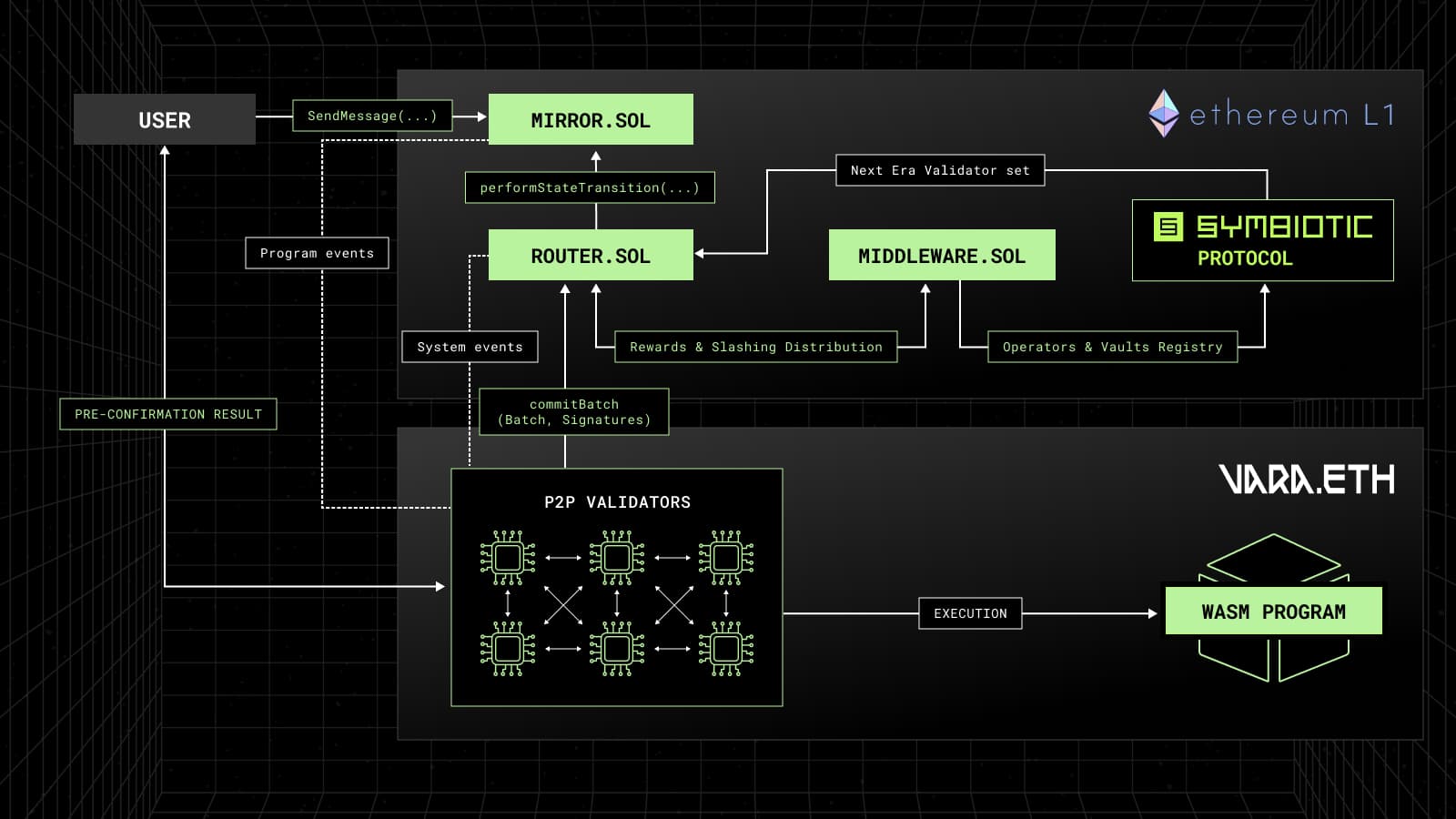
How It Differs from L2s
Key Distinction
Vara.eth is not a rollup. It doesn't produce its own blocks, doesn't maintain shared state, and doesn't require a centralized sequencer. It's an application layer, not a new chain.
| Feature | L2 Rollup | Vara.eth |
|---|---|---|
| Own blockchain | ❌ Yes (separate chain) | ✅ No (anchored to Ethereum L1) |
| Bridging required | ❌ Yes | ✅ No (native L1 contracts) |
| Finality | Minutes to days | Ethereum-native + instant pre-confirmations |
| Parallel execution | Limited | ✅ Native per-program |
| Memory limit | Gas-constrained | Up to 2 GB per program |
| Who pays gas? | User pays | Program pays (reverse gas) |
Two Interaction Paths
| Path | Mechanism | Latency | Cost |
|---|---|---|---|
| Ethereum-side | Transaction to Mirror contract on L1 | ~12s (L1 block) | ETH gas + wVARA |
| Vara.eth-side | Injected transaction directly to validators | Sub-second | No ETH gas |
The Ethereum-side path is used for on-chain settlement, value transfers, and Solidity composability. The Vara.eth-side path bypasses Ethereum entirely — messages go straight to validator nodes for instant execution and pre-confirmations.
Both paths are unified in the @vara-eth/api TypeScript SDK.
Key Terminology
Mirror Contract
The on-chain Ethereum representation of your program. Users send messages to the Mirror.
Router Contract
Central Ethereum contract that coordinates code registration, program creation, and batch settlement.
Gear Program
A WASM module that runs inside the Gear runtime, representing your application's logic.
Executable Balance
wVARA tokens that fund your program's execution costs (reverse gas model).
Pre-confirmation
Instant feedback from executors before the transaction is finalized on Ethereum L1.
Injected Transaction
A message sent directly to Vara.eth validators, bypassing Ethereum for sub-second execution.
For the full list of terms, see the Glossary.
Architecture Deep Dive
Vara.eth's architecture is described in detail in the Vara.eth Whitepaper, Technical Documentation, and the GitHub Repository.